Digital Accessibility Ethics Book
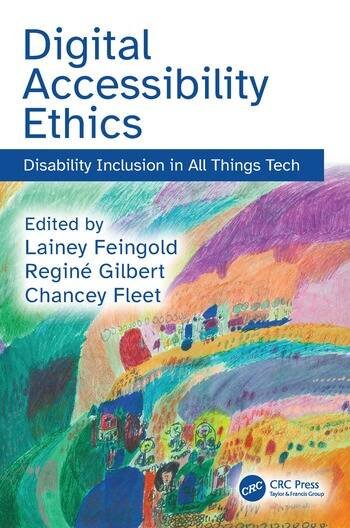
Welcome. This page has information about a new book called Digital Accessibility Ethics: Disability Inclusion in All Things Tech. Margaux Joffe wrote a chapter in this book.
On this page you can:
About the Book

What is this book about?
Digital Accessibility Ethics: Disability Inclusion in All Things Tech is a new book. The book is about making digital technology that everyone can understand and use. Digital technology includes websites, apps, and software.
Why is this book important?
Technology helps us learn, work, get healthcare and be included in our communities. When people who make technology do not make it accessible, many people get left out. Over 1 billion people around the world live with a disability. Technology often does not work for them. Excluding people with disabilities is a form of discrimination. That is why we wrote this book.
Who wrote the book?
A group of accessibility experts and people with disabilities wrote the book. There were 39 authors from 10 countries and 1 commonwealth.
Three people led the project: Lainey Feingold, Chancey Fleet and Reginé Gilbert.
Margaux Joffe wrote chapter 8. Her chapter is called “Empower All Minds: Cognitive Accessibility Ethics.”
About the book cover art
The cover shows the title in large blue letters at the top. Below the title is a colorful painting by Ana Maria Vidalon. Ana Maria Vidalon is a Creativity Explored artist. Creativity Explored is a nonprofit art organization in San Francisco that works with artists with disabilities.
The painting has curved lines of bright color. The colors include yellow, orange, blue, turquoise, pink, and purple. Near the bottom are small shapes that look like people, circles, and buildings. The artist was inspired by sheet music. The colors and shapes create a feeling of musical rhythm.
Text on the upper left of the cover says the book was edited by Lainey Feingold, Reginé Gilbert, and Chancey Fleet. The CRC Press logo is in the bottom right corner.
About my chapter
“Empower All Minds: Cognitive Accessibility Ethics.”

Cognitive accessibility means making technology easy for all minds to use. When technology is built this way, everyone can take part in their community.
More than 1 in 10 people in the United States have disabilities that affect how they think, learn, or remember things. (CDC, 2024) That is why technology needs to include different brain types.

In this chapter you can learn why cognitive accessibility is important. You can also get practical tips and real examples of how you can make your work better.

The chapter ends with real stories of people creating new and better ways to do things. Including:
A group of people with Schizophrenia in Japan who started a new way to research mental health disabilities.
A group of people with disabilities in the United States helping make laws easier to understand.
A person with Dyslexia and ADHD who helped the BBC make a font that is easier to read.
Where to learn more about Cognitive Accessibility

Web Content Accessibility Guidelines (WCAG)
The World Wide Web Consortium (W3C) made the Web Content Accessibility Guidelines (WCAG). WCAG is list of rules which help people make websites easier for disabled people to use. Many countries use WCAG in their laws. WCAG has some rules for cognitive accessibility.
Learn about the guidelines
Get a version of the guidelines in Plain English from AARdvark
Read W3C supplemental guidance for cognitive and learning disabilities
Evaluating websites
WebAIM (Web Accessibility In Mind) is a non-profit group that has worked on web accessibility since 1999.

Write so everyone can understand
People with disabilities deserve equal access to information. These resources can help you write in a way that is easier understand.
Plain Language
Plain language is a style of writing that uses everyday words, short sentences and examples to help readers understand ideas.
Read the Autistic Self Advocacy Network’s guide to plain language (PDF)
Easy Read
Easy Read is a way to format information using simple words and pictures. Easy Read was made for people with intellectual and developmental disabilities (IDD). But Easy Read can help many other people too!
Get the Autistic Self Advocacy Network’s Guide to Making Easy Read Resources
Inclusion Europe “Information For All”
Inclusion Europe made standards for making written information easy to read and understand.
Download the Inclusion Europe “Information For All” Standards (PDF)

Inclusive Design
These resources can help you make better design choices.
Inclusive Design
Microsoft made several inclusive design guidebooks:
Read Microsoft’s Inclusive Design for Cognition Guidebook (2023)
Read Microsoft’s Inclusive Design for Mental Health Guidebook (2024)
Fonts
There is no such thing as the most accessibility font, but some are more readable than others. Other choices like font weight and spacing matter too.
Do not write body copy in ALL CAPS. Use Title Case or Sentence case instead.
Avoid fonts that are too thin, decorative, or condensed.
Read “Understanding What Makes a Typeface Accessible” by Gareth Ford Williams
Get a designers guide to font accessibility from A11y Collective
Download free Hyperlegible Fonts from the Braille Institute
Charts and Graphs
It is common to show data with charts, graphs, and other pictures. To make it easy to understand you want to reduce cognitive load. Cognitive load means how much mental effort something takes.
Read Chapter 3 “Designing Data for Cognitive Load (PDF) by Doug Schepers
Numbers
Laura Parker created the The Accessible Numbers Project. It is a guide to help designers make numbers easier to understand. Laura Parker is a designer with Dyscalculia, a difficulty in understanding numbers.

Listen to the community
It’s important to listen to people with disabilities so you can understand what is important to them, and what they need. Here are a few helpful organizations and resources.
Autistic Self Advocacy Network (ASAN) - ASAN makes resources created by and for autistic people. Visit ASAN’s Website
People First of the USA - People First is a national self-advocacy organization. This organization is led by people with intellectual and developmental disabilities. Visit People First’s Website
The Neurodiversity Smorgasbord - S.J. Wise created the Neurodiversity Smorgasbord. It is a way to understand brain differences without using medical labels. Read the Neurodiversity Smorgasbord
Sins Invalid - Sins Invalid created “Skin, Tooth, and Bone.” This is a book about disability justice. This book shares the experiences of disabled people of color. Learn about Sins Invalid
Disability Visibility Project - The Disability Visibility Project is a website created by Alice Wong that shares disability stories. There are many articles about cognitive disabilities. For example, Hector Ramirez wrote this essay: “After 30 Years the ADA Leaves People with Psychiatric Disabilities Behind.” This essay explains that people with psychiatric disabilities still have problems getting disability rights. Read the essay on the Disability Visibility Project
How Disability Policy is affecting disabled people - Liz Weintraub is a person with an intellectual disability. Liz works at the Association of University Centers on Disabilities (AUCD). She hosts a show policy language easier to understand. Learn more about “Tuesdays With Liz: Disability Policy For All."
Alice Wong on Ableism and AAC - Alice Wong gave a speech about ableism and AAC. Ableism means unfair treatment of disabled people. AAC means augmentative and alternative communication. AAC includes tools people use to communicate in different ways, such as picture boards and text-to-speech apps. Watch on YouTube
CommunicationFIRST - CommunicationFirst is a nonprofit organization started by Jordyn Zimmerman a nonspeaking Autistic person. Their mission is to protect the rights of people with speech-related disabilities. Read tips for meeting with AAC Users, by AAC Users

Thank you to the people who helped with this chapter
Thank you to the many accessibility professionals, disability advocates, scholars, and neurodivergent community members who helped with this chapter.
Special thanks to:
AJ Link (he/him) is quoted in this chapter. AJ is an openly autistic advocate in Washington D.C. AJ is the Director of Policy at New Disabled South, a disability justice nonprofit in the United States. AJ previously worked at the Autistic Self Advocacy Network.
Albert Kim (he/him) reviewed this chapter and shared feedback. Albert is a neurodivergent accessibility professional in Seoul, South Korea. He worked with W3C as an invited expert on the Cognitive and Learning Disabilities Task Force (COGA) and Mental Health Sub-Group.
Eric Garcia (he/him) edited this chapter. Eric is an autistic journalist in Washington D.C. He wrote the book We’re Not Broken: Changing the Autism Conversation. He reports on Congress, the White House, and disability policy.
Frankie Wolf (they/them) shared expertise for this chapter. Frankie works with W3C as an invited expert in the Accessibility Guidelines Working Group. They were also a member of the Cognitive and Learning Disabilities Accessibility Task Force from 2023-2024. Frankie is neurodivergent, queer and disabled.
Gabriel Joffe (they/them) reviewed the chapter and shared feedback. Gabriel works in executive communications and inclusive communications strategy.
Gareth Ford Williams (he/him) is quoted in the chapter. Gareth has dyslexia and ADHD. He founded the BBC’s Digital Accessibility Team in 2005. He also helped develop a more readable font for the BBC.
Haben Girma (she/her) reviewed the chapter and shared feedback. Haben is an American human rights lawyer. She wrote the bestselling book Haben: The Deafblind Woman Who Conquered Harvard Law.
Jonathan Katz-Ouziel (he/him) share expertise for the chapter. He is a certified accessibility professional. He works on accessibility, aging and disability policy. He used to work for the United States government in the Office of Disability Employment Policy (ODEP).
Lainey Feingold (she/her) edited this chapter. Lainey is a disability rights lawyer and an author. For more than twenty-five years she has worked on technology accessibility and information access. Lainey worked on the first legal agreements in the United States to make ATMs and the internet accessible for blind people. Lainey is one of the lead authors of Digital Accessibility Ethics: Advancing Inclusion in Everything Tech.
Larry Goldberg (he/him) reviewed this chapter and shared feedback. Larry previously directed the National Center for Accessible Media at GBH in Boston. He helped develop major U.S. accessibility laws, standards, and tools including the Twenty-First Century Communications and Video Accessibility Act (CVAA).
Laura Parker (she/her) is featured in this chapter. Laura is an independent senior content designer currently working in UK government. She has dyscalculia. Dyscalculia is a disability that affects how people understand numbers. In 2023 she created The Accessible Numbers Project.
Liz Weintraub (she/her) is quoted in this chapter. Liz is a person with an intellectual disability and a lifelong self-advocate. She works at the Association of University Centers on Disabilities (AUCD). She is the author of All Means All: My Life in Advocacy.
Professor Shinichiro Kumagaya (he/him) and Professor Satsuki Ayaya (she/her) shared an interview for this chapter. They work at the University of Tokyo in Japan. They study Tojisha-Kenkyu: self-supported research created by people with mental health disabilities. Professor Ayaya is autistic and Professor Kumaya lives with Cerebral Palsy.
Susanne M. Bruyère, Ph.D. (she/her) Dr. Bruyère reviewed this chapter and shared feedback. She is Director of the Yang Tan Institute on Employment and Disability at Cornell University. She is a leading scholar and advisor on disability employment. She is also co-editor of Neurodiversity in the Workplace: Interests, Issues, and Opportunities (Routledge, 2023).
Thank you to my friends and family and to the support from early readers in the Minds of All Kinds community. 💜
Chapter Bibliography
Formal list of references and citations I used in writing the chapter
AAArdvark Accessibility. “WCAG in Plain English: Making the Web Content Accessibility Guidelines (WCAG) Easy to Understand, One Success Criterion at a Time.” Accessed July 12, 2025. https://aaardvarkaccessibility.com/wcag-version/2-2/.
A11Y Collective. “Best Practices for Cognitive Accessibility in Web Design.” Accessed July 12, 2025. https://www.a11y-collective.com/blog/cognitive-accessibility/.
American Psychiatric Association, DSM-5 Task Force. (2013). Diagnostic and statistical manual of mental disorders: DSM-5™ (5th ed.). American Psychiatric Publishing, Inc. https://doi.org/10.1176/appi.books.9780890425596
Autistic Self Advocacy Network. One Idea Per Line: A Guide to Making Easy Read Resources. Accessed July 12, 2025. https://autisticadvocacy.org/resources/accessibility/easyread/.
Autistic Self Advocacy Network. Plain Language for Self-Advocates. April 2022. https://selfadvocacyinfo.org/wp-content/uploads/2022/04/Plain-Language-for-Self-Advocates.pdf.
Ayaya, Shuntaro, and Junko Kitanaka. “Japan’s Radical Alternative to Psychiatric Diagnosis.” Aeon, June 12, 2023. https://aeon.co/essays/japans-radical-alternative-to-psychiatric-diagnosis.
Brouwers, Domenique. “Creating Zines for the Neighbourhoods: Our People, Our Places Study.” Dementia Researcher (blog), December 2, 2019. https://www.dementiaresearcher.nihr.ac.uk/guest-blog-creating-zines-for-the-neighbourhoods-our-people-our-places-study/.
Communication First. “Alice Wong: AAC Research Summit Remarks, ‘How Ableism Impacts People Who Need and Use AAC.’” YouTube video. Accessed July 12, 2025. https://www.youtube.com/watch?v=erLtOogjpys.
Gernsbacher, Morton Ann. “Video Captions Benefit Everyone.” Policy Insights from the Behavioral and Brain Sciences 2, no. 1 (2015): 195–202. https://doi.org/10.1177/2372732215602130.
GOV.UK. “Making Written Information Easier to Understand for People with Learning Disabilities: Guidance for People Who Commission or Produce Easy Read Information (Revised Edition 2010).” November 25, 2010. https://www.gov.uk/government/publications/making-written-information-easier-to-understand-for-people-with-learning-disabilities-guidance-for-people-who-commission-or-produce-easy-read-information-revised-edition-2010.
Hemingway App. Accessed July 12, 2025. https://hemingwayapp.com.
Inclusion Europe. European Standards for Making Information Easy to Read and Understand: Information for All. January 2023. https://easy-to-read.eu/wp-content/uploads/2023/01/EN_Information_for_all.pdf.
InclusionHub. Jankowski, R. “Improving Web Content Accessibility Guidelines (WCAG) for Mental Health Disabilities.” April 6, 2022. https://www.inclusionhub.com/articles/improving-wcag-for-mental-health.
International Association of Accessibility Professionals. IAAP. Accessed July 1, 2025. https://www.accessibilityassociation.org/.
Katz, Jonathan. Planning for Dementia-Friendly Communities. PAS Memo (November–December 2021). American Planning Association. https://www.planning.org/publications/document/9223876/.
Lange, A. “What Makes a Font Accessible? A Designer’s Guide.” The A11Y Collective, April 4, 2024. https://www.a11y-collective.com/blog/accessible-fonts/.
Lazaridis, Christos. “Informed Consent and Decision-Making for Patients with Acquired Cognitive Impairment.” Neurologic Clinics 41, no. 3 (2023): 433–442. https://doi.org/10.1016/j.ncl.2023.03.001.https://pubmed.ncbi.nlm.nih.gov/37407097/.
Le Garrec, Q. “What Is the Price of Our Attention?” Epoché Magazine, July 2019. https://epochemagazine.org/24/what-is-the-price-of-our-attention/.
Levine, S. Z., A. Rotstein, A. Kodesh, et al. “Adult Attention-Deficit/Hyperactivity Disorder and the Risk of Dementia.” JAMA Network Open 6, no. 10 (2023): e2338088. https://doi.org/10.1001/jamanetworkopen.2023.38088.https://jamanetwork.com/journals/jamanetworkopen/fullarticle/2810766.
Mariger, H. “Cognitive Disabilities and the Web: Where Accessibility and Usability Meet.” National Center on Disability and Access to Education. Accessed July 12, 2025. https://ncdae.org/resources/articles/cognitive/.
Microsoft. Inclusive Design for Cognition Guidebook. 2023. https://inclusive.microsoft.design/tools-and-activities/InclusiveDesignForCognitionGuidebook.pdf.
Microsoft. Inclusive Design for Cognition Recruitment Screener. 2023. https://inclusive.microsoft.design/tools-and-activities/InclusiveDesignForCognitionScreeners.pdf.
Microsoft. Inclusive Design for Mental Health. 2024. https://inclusive.microsoft.design/tools-and-activities/MentalHealthGuidebook.pdf.
Microsoft. “Accessibility Tools for Neurodiversity.” 2023. https://support.microsoft.com/en-us/topic/accessibility-tools-for-neurodiversity-6dbd8065-b543-4cf8-bdfb-7c84d9e8f74a.
Museum of Flight. “Accessibility.” Accessed July 12, 2025. https://www.museumofflight.org/visit/accessibility.
National Center on Disability and Journalism. Disability Language Style Guide (Revised 2021). August 2021. https://ncdj.org/style-guide/.
National Health Service (UK). “Inclusive Content.” NHS Service Manual. Accessed July 12, 2025. https://service-manual.nhs.uk/content/inclusive-content.
“Neighbourhoods and Dementia: A Mixed Methods Study (ESRC Grant Reference ES/L001772/1).” Accessed July 12, 2025. https://sites.manchester.ac.uk/neighbourhoods-and-dementia/?ID=3314.
New Disabled South. “Plain Language Policy Dashboard.” Accessed July 11, 2025. https://policy-dashboard.newdisabledsouth.org.
Open Collaboration for Cognitive Accessibility. “Towards a Functional Definition of Cognitive Disability.” University of Ottawa and Université du Québec à Trois-Rivières. 2024. Accessed July 11, 2025. https://openaccessibility.ca/definition-of-cognitive-disability/.
Opal, Jennifer. Accessed July 12, 2025. https://jenniferopal.com/.
Parker, Laura. “Living with Dyscalculia.” LinkedIn article. Accessed July 12, 2025. https://www.linkedin.com/pulse/living-dyscalculia-laura-parker-qbgme/.
Parker, Laura. “Accessible Numbers Project.” Accessed July 12, 2025. https://accessiblenumbers.com.
People First of the USA. “USA.” Accessed July 12, 2025. https://www.peoplefirst.org/usa.
Plain Truth Project. Accessed July 12, 2025. https://www.plaintruthproject.org.
Ramírez, Hector M. “After 30 Years the ADA Leaves People with Psychiatric Disabilities Behind.” Disability Visibility Project, July 19, 2020. https://disabilityvisibilityproject.com/2020/07/19/after-30-years-the-ada-leaves-people-with-psychiatric-disabilities-behind/.
Readable. Accessed July 12, 2025. https://readable.com.
Rewordify. Accessed July 12, 2025. https://rewordify.com.
Rubenstein, E., S. Tewolde, S. Michals, et al. “Alzheimer Dementia Among Individuals With Down Syndrome.” JAMA Network Open 7, no. 9 (2024): e2435018. https://doi.org/10.1001/jamanetworkopen.2024.35018. https://jamanetwork.com/journals/jamanetworkopen/fullarticle/2823874.
Sant Pau Memory Unit. “Unidad Alzheimer y Síndrome de Down.” Accessed July 12, 2025. https://santpaumemoryunit.com/es/unidad-alzheimer-down/.
Schwabish, Jonathan, Susan J. Popkin, and Alice Feng. Do No Harm Guide: Centering Accessibility in Data Visualization. Urban Institute, December 14, 2022. https://www.urban.org/sites/default/files/2022-12/Do%20No%20Harm%20Guide%20Centering%20Accessibility%20in%20Data%20Visualization.pdf.
Sins Invalid. Skin, Tooth, and Bone: The Basis of Movement Is Our People: A Disability Justice Primer. 2nd ed. Berkeley, CA: Sins Invalid, 2019. https://www.sinsinvalid.org/skin-tooth-and-bone.
Tojisha-Kenkyu Kumagaya Laboratory. Research Center for Advanced Science and Technology, University of Tokyo. Accessed July 12, 2025. https://www.rcast.u-tokyo.ac.jp/en/research/kumagaya_lab.html.
United States Congress. Plain Writing Act of 2010, Pub. L. No. 111–274. Accessed July 12, 2025. https://www.govinfo.gov/app/details/PLAW-111publ274/related.
Vallas, Rebecca, Kelsey Knackstedt, and Veronica Thompson. “7 Facts About the Economic Crisis Facing People with Disabilities in the United States.” The Century Foundation, April 21, 2022. https://tcf.org/content/commentary/7-facts-about-the-economic-crisis-facing-people-with-disabilities-in-the-united-states/.
WebAIM. “Contrast Checker.” Accessed July 11, 2025. https://webaim.org/resources/contrastchecker/.
WebAIM. “Evaluating Cognitive Web Accessibility.” February 2020. Accessed July 12, 2025. https://webaim.org/articles/evaluatingcognitive/.
Weintraub, Liz. All Means All: My Life in Advocacy. Independently published, January 2025. ISBN 979-8326748065.
Wise, S. J. “The Neurodiversity Smorgasbord: An Alternative Framework for Understanding Differences Outside of Diagnostic Labels.” Lived Experience Educator, September 27, 2024. Accessed July 20, 2025. https://www.livedexperienceeducator.com/blog/theneurodiversitysmorgasbord/.
World Wide Web Consortium (W3C). “Cognitive Accessibility.” Web Accessibility Initiative. Accessed July 1, 2025. https://www.w3.org/WAI/cognitive/.
World Wide Web Consortium (W3C). “Cognitive Disabilities.” Web Accessibility Initiative. Updated 2024. Accessed July 1, 2025. https://www.w3.org/WAI/people-use-web/abilities-barriers/cognitive/.
World Wide Web Consortium (W3C). “Making Content Usable for People with Cognitive and Learning Disabilities.” W3C Recommendation. Accessed July 1, 2025. https://www.w3.org/TR/coga-usable/.
World Wide Web Consortium (W3C). “Web Content Accessibility Guidelines (WCAG).” Web Accessibility Initiative. Accessed July 1, 2025. https://www.w3.org/WAI/standards-guidelines/wcag/.
World Wide Web Consortium (W3C). “WCAG 2 Supplemental Guidance.” Web Accessibility Initiative. Accessed July 1, 2025. https://www.w3.org/WAI/WCAG2/supplemental/#cognitiveaccessibilityguidance.
Williams, G. Ford. “A Guide to Understanding What Makes a Typeface Accessible and How to Make Informed Decisions.” Medium (The Readability Group), August 14, 2020. https://medium.com/the-readability-group/a-guide-to-understanding-what-makes-a-typeface-accessible-and-how-to-make-informed-decisions-9e5c0b9040a0.